Why We Stopped Offering Same-Day Non-Emergency Appointments
Rushing through non-emergency HVAC calls leads to misdiagnosis and repeat breakdowns. We changed our scheduling model to ensure technicians have the time to fix your system right.

Federal tax credits for heat pump upgrades can put real money back in your pocket when you file your 2025 taxes in 2026. If you installed a qualifying heat pump in your home before December 31, 2025, you may be eligible to claim a credit worth up to $2,000 — and that's just for the heat pump alone. When combined with other energy-efficient improvements, the total annual credit can reach $3,200.
Here's a quick snapshot of what the credit covers:
| Detail | Amount |
|---|---|
| Credit percentage | 30% of qualified costs |
| Maximum credit for heat pumps | $2,000 per year |
| Maximum total annual credit (all improvements) | $3,200 |
| Electrical panel upgrade credit | Up to $600 |
| Credit expiration | December 31, 2025 (claimable on 2025 taxes) |
| Refundable? | No |
| Carryforward allowed? | No |
This credit falls under Section 25C of the tax code, also known as the Energy Efficient Home Improvement Credit, which was expanded under the Inflation Reduction Act. It applies to existing homes — not new construction — and covers both homeowners and, in some cases, renters. There are no income limits to qualify, but your credit cannot exceed the amount you owe in federal taxes.
Whether you're a homeowner in Mesa, Gilbert, or anywhere in the Phoenix Valley, understanding how this credit works can help you make the most of your heat pump investment before the deadline passes.

The 25C credit is a game-changer for anyone looking to improve their home’s comfort and efficiency. Essentially, the federal government allows you to deduct 30% of the total cost of purchasing and installing a qualifying heat pump from your federal income tax bill. This includes not just the unit itself, but also the labor costs associated with the installation.
For residents in the Phoenix Valley, switching to a heat pump isn't just about the tax break; it’s about long-term sustainability. Heat pumps are incredibly efficient because they move heat rather than creating it through combustion. During our scorching Arizona summers, they act as high-efficiency air conditioners, and during our cool desert nights, they provide reliable warmth. You can learn more about the financial impact of these systems in our guide on Heat Pump Energy Savings.
While air-source heat pumps fall under the 25C credit with a $2,000 annual cap, it is important to distinguish them from geothermal systems. Geothermal heat pumps fall under a different section of the tax code (Section 25D) and offer different incentives.
| Feature | 25C (Air-Source Heat Pumps) | 25D (Geothermal Heat Pumps) |
|---|---|---|
| Credit Percentage | 30% | 30% |
| Annual Credit Cap | $2,000 | No specified dollar cap |
| Labor Costs Included? | Yes | Yes |
| Primary/Secondary Home | Both qualify | Both qualify |
| Expiration | Dec 31, 2025 | Through 2034 (percentage drops after 2032) |
You might be wondering how the math works if you decide to do more than just a heat pump upgrade. The IRS has established an aggregate annual limit of $3,200 for all energy-efficient improvements combined.
This total is generally split into two "buckets":
By planning your upgrades strategically, you can maximize these limits. For example, if we install a new heat pump in your Gilbert home, you can claim the $2,000 credit. If you also decide to upgrade your attic insulation and seal air leaks in the same year, you can claim an additional $1,200, bringing your total tax savings to the $3,200 max.
To ensure you can actually claim the federal tax credits for heat pump upgrades, you need to meet specific eligibility criteria set by the IRS. The most important rule is that the equipment must be installed in an existing home located in the United States. New construction projects do not qualify for the 25C credit.
The home must be used as a residence by the taxpayer. While the credit is primarily designed for your "principal residence" (the place where you live most of the time), some components of the credit can also apply to secondary homes that you use as a residence. However, you cannot claim this credit for a property that you use exclusively as a landlord for rental income.
For more details on choosing the right system for your home, check out our Energy Efficient Heat Pump Guide.
Not every heat pump on the market qualifies for the tax credit. The IRS requires that the equipment meet or exceed the highest efficiency tier (not including the "advanced" tier) established by the Consortium for Energy Efficiency (CEE) that was in effect at the start of the year the equipment was installed.
Starting in 2025, the standards became even more specific. To qualify, most air-source heat pumps must be ENERGY STAR Most Efficient certified. For those of us in the "Southern Tier" (which includes all of our service areas like Phoenix, Mesa, and Scottsdale), the requirements generally look like this:
Because these ratings can be technical, we always recommend verifying the specific model's eligibility through the ENERGY STAR website or by asking us for the manufacturer’s certification statement.
The 25C credit is quite flexible regarding the type of home you live in. Qualifying property types include:
A note for renters: If you are a tenant and you pay for the installation of a qualifying heat pump in your primary residence (with the landlord's permission, of course), you may be eligible to claim the credit.
Business Use Proration: If you use part of your home for business (for example, a home office), the credit is still available. If your business use is 20% or less, you can claim the full credit. If you use more than 20% of your home for business, the credit must be prorated based on the percentage of the home used for residential purposes.
Claiming your credit happens when you file your annual federal income tax return. You don't get the money at the time of purchase; instead, it reduces the amount of tax you owe dollar-for-dollar.
To claim the credit for a 2025 installation, you will use IRS Form 5695, Residential Energy Credits. You'll fill out Part II of this form to calculate your 25C credit and then carry that amount over to your Form 1040. If you are looking for ways to manage the initial investment before tax season arrives, our Heat Pump Installation Financing Guide offers several helpful options.
The IRS doesn't require you to attach every receipt to your tax return, but you must keep them in your records in case of an audit. To be fully prepared, you should gather the following:
When tax season rolls around in early 2026, follow these steps to claim your 2025 heat pump installation:
Important Reminder: This is a non-refundable credit. This means if you owe $1,500 in taxes but qualify for a $2,000 credit, your tax bill will drop to zero, but the IRS will not send you a check for the remaining $500. Additionally, the 25C credit does not allow for a carryforward—any unused credit amount is lost and cannot be used in future tax years.
One of the best things about the current incentive landscape is that you don't have to choose just one program. You can often "stack" federal tax credits with state rebates and utility incentives to drive down the cost of your project significantly.
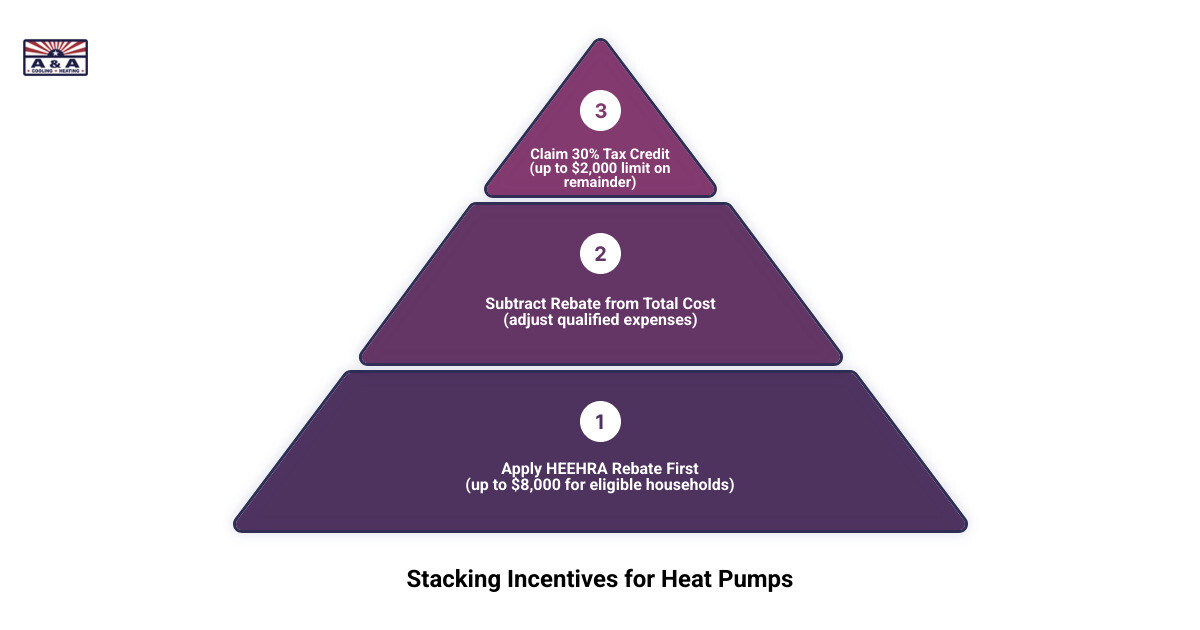
For instance, the High-Efficiency Electric Home Rebate Act (HEEHRA) provides point-of-sale rebates for low-to-moderate-income households. These rebates can cover up to $8,000 for a heat pump installation. If you qualify for a rebate, you can still claim the federal tax credit, but you must subtract the rebate amount from your total project cost before calculating the 30% credit.
To see how these programs work together, visit our page on how to Save Thousands On Your New Hvac With Federal State Incentives.
Modern, high-efficiency heat pumps sometimes require more electrical "juice" than an older home’s electrical panel can provide. If your upgrade requires a new panelboard, sub-panel, or specialized branch circuits to accommodate the heat pump, the IRS offers a specific credit for this.
You can claim 30% of the cost of an electrical panel upgrade, capped at $600 per year. To qualify, the upgrade must be installed in accordance with the National Electric Code and must be necessary to support the new energy-efficient property (like your heat pump). This is a great way to modernize your home’s electrical system while getting a tax break. For a deeper look at system components, see our Heat Pump Systems A Comprehensive Guide.
To get the most out of a new heat pump, your home’s "envelope" should be tight. The federal government encourages this by offering credits for:
By combining these with your heat pump, you can reach the full $3,200 annual credit limit.
Generally, no. The 25C credit is for "residential energy property," which requires the taxpayer to use the home as a residence. If you are a landlord who does not live in the property, you cannot claim the credit for improvements made to your tenants' units. However, if you are a renter and you pay for the upgrade in your own primary residence, you may be eligible.
Because the 25C credit is non-refundable, it can only reduce your tax liability to zero. If you have a $2,000 credit but only owe $1,200 in taxes, your tax bill will be eliminated, but you will not receive the remaining $800 as a refund. Furthermore, you cannot "carry over" that extra $800 to use on next year's taxes.
No. Geothermal heat pumps fall under the Residential Clean Energy Credit (Section 25D). This credit is also 30% of the total cost, but it does not have the $2,000 annual cap that applies to air-source heat pumps. Additionally, the 25D credit does allow you to carry forward any unused portion of the credit to future tax years.
Upgrading to a heat pump is one of the smartest moves you can make for your home's comfort and your wallet. Between the immediate tax savings of up to $2,000 and the long-term energy efficiency gains, the value is clear. Whether you live in Apache Junction, Mesa, Gilbert, or Peoria, our team is here to help you navigate the technical requirements to ensure your new system qualifies for every possible incentive.
We have been serving the Phoenix Valley since 1976, providing tailored HVAC solutions that keep Arizona families comfortable year-round. From professional installation to our Cool Club maintenance plan, we are committed to your long-term satisfaction. To learn more about why now is the perfect time to switch, read about the Heat Pump Replacement Benefits.
Ready to upgrade? Contact our experts for professional heat pump services today! We proudly serve Apache Junction, Chandler, Queen Creek, San Tan Valley, Scottsdale, Tempe, and the entire Phoenix metropolitan area. Let us help you maximize your savings and your comfort!


A & A is professional, fast, and honest. They have a hometown work ethic and take care of you almost like family! Dave is a great tech and I would recommend him to anyone. We had our AC go out and they came out and stayed past 7 pm to keep us cool on a day when temps were going to reach 105! THANK YOU!

Excellent service, they are very dependable and upfront about the work. I would highly recommend this company for any heating or cooling issues. Being a snowbird it’s often scary finding reliable services, this is one company you can count on.

A & A is professional, fast, and honest. They have a hometown work ethic and take care of you almost like family! Dave is a great tech and I would recommend him to anyone. We had our AC go out and they came out and stayed past 7 pm to keep us cool on a day when temps were going to reach 105! THANK YOU!